

Overview of NGO Registration
A non-profit organisation that works independently. You can register your NGO as a Trust, Society, CSR, NGO Darpan, 12A & 80G, and as a section 8 company. According to the work policy of the organisation, you may continue as one of the above categories.
For understanding the registration process, one must understand how an NGO works in the development of society. An NGO is completely a non-profit organisation that works only for the welfare of society earning zero profit from their business. But their activities do not limit themselves to the environment, social, human rights, and advocacy only. The work boundary of an NGO is wider & greater than it.
An NGO can play out on a demographic scale in developing society by improving communities, promoting citizen participation, preparation for any emergency, economic development, education, and the geopolitical section of the country.
You can register your NGO in any of the following.
- Trust
- Society
- Section 8 Companies
- CSR Registration
- NGO Darpan Registration
- 12A & 80G Registration
NGO Registration
Benefits of NGO Registration in India:
Benefits of NGO Registration in India:
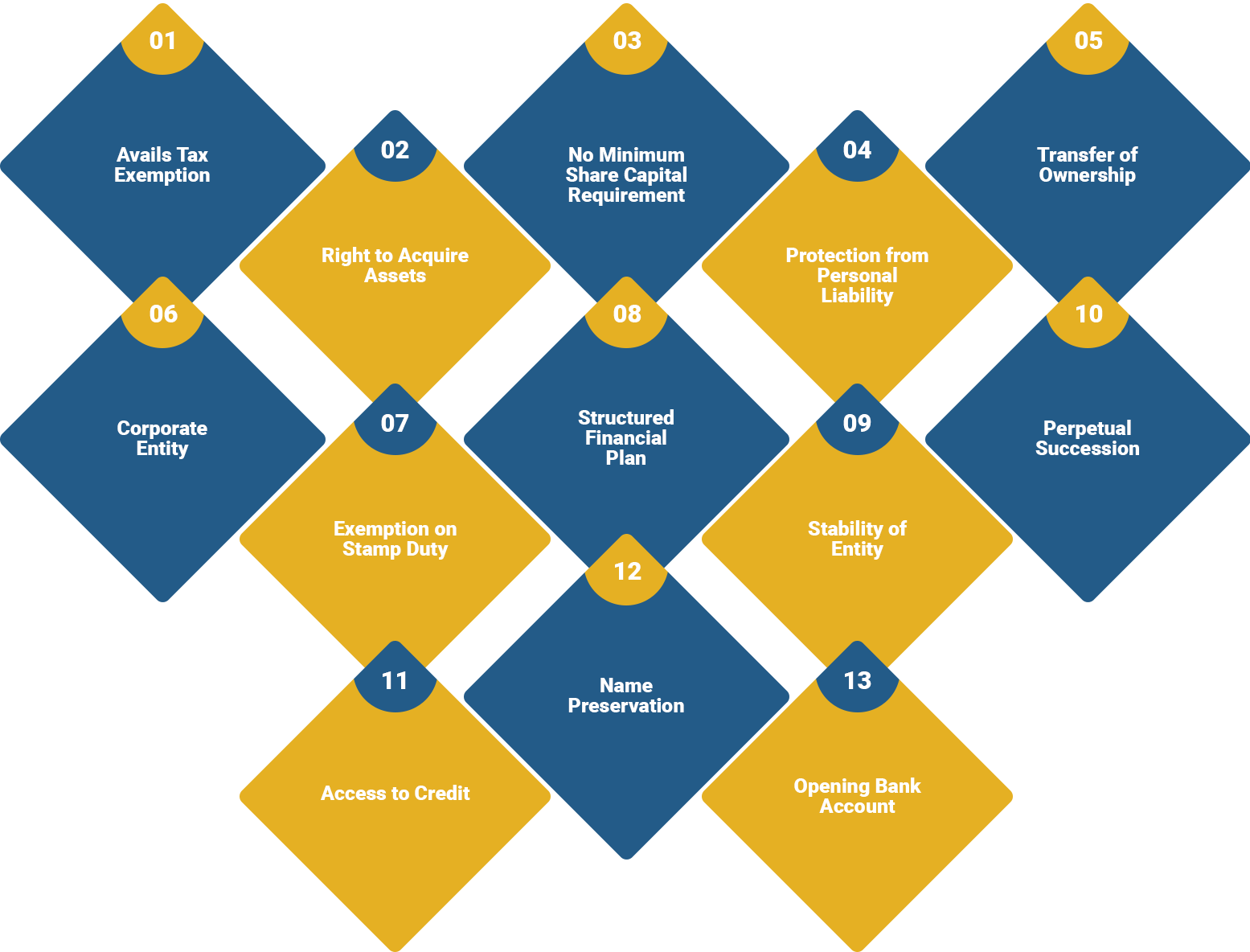
- Avails Tax Exemption:
- Right to Acquire Assets:
- No Minimum Share Capital Required:
- Protection from Personal Liability:
- Transfer of Ownership:
- Corporate Entity:
- Exemption on Stamp Duty:
- Structured Financial Plan:
- Stability of Entity:
- Perpetual Succession:
- Admission to Credit:
- Name Preservation:
- Opening Bank Account:
Companies Act, 2013 exempts all NGOs from several taxations. This taxation benefits results in saving money and utilising it in helping the needy people of the country.
No unregistered NGO can own land or property. Only after the official registration, your NGO will be free to buy lands, own fixed properties, and even have liabilities under the company’s common seal. You can further sell these assets or liabilities anywhere.
An NGO is free to work at a minimal capital share also. After registration, your NGO doesn’t need to have a minimum capital limit. You can run your projects and operations with the minimum donations from charity and funding.
You can buy and acquire lands and other assets in the name of your NGO. This further helps you to gain protection from unlimited liability for an untoward occurrence such as judgement, debt, divorce, bankruptcy, and foreclosure.
The Income Tax act 1961 and the Companies Act 2103 free all NGOs from the restriction on the transfer of their ownership or claims of the interest earned. You can transfer the ownership to anyone you feel worthy.
NGOs are considered corporate entities. Hence your NGO will improve the involvement and relations with the communities. The NGO has the authority to sue to enforce its legal rights. On the other hand, NGO trustees can also sue it and vice-versa.
The Indian Government allows the exemption on Stamp Duty for all NGOs. The Income Tax Act, Section 8 allows you to gain exemption on stamp duty and opens up many doors to save your tax. This saved money must be used for the promotion of projects by the company. This also makes saving more funding smoothly.
Like every organisation, an NGO can also design its financial transaction in a structured way. As the Government has allowed the exemption of taxes for NGOs, you can therefore create a financial structure without taxes.
Being a registered NGO means you have authority in your name. A registered organisation shows capable leadership and effective operations under the NGO. Several top-tier people and companies prefer to connect with a registered NGO only. This further helps you to gain popularity, funding, and official support.
A registered NGO can carry out its work for an unlimited time even if the founders die or leave the NGO. The NGO can follow the perpetual succession also. Only an official order from the judiciary of India can stop its work of operations.
By registering your NGO in official documents, you open up the doors of financial credits in your favour. You can take credits from lenders, and financial institutions. You can also go for acquiring lands & fixed assets. For granting a loan in the NGO's name, you must show the registration document to the bank.
Once you have registered a name for the NGO, no one can use it further for his/ her benefit throughout India. You have all the rights to use your corporate image and name for all your operations and can sue the unauthorised uses of your name.
Banks generally do not prefer any transaction for your NGO in your personal name. Once you have registered your organisation, it will help both sides to keep all the transactions transparent. It will help banks and donors to understand the actual corporate existence of the NGO organisation. For opening a bank account, you must have registered yourself in the government’s official records.
Classifications of NGOs in India.
The Indian government has classified all NGOs into two types.
- By the level of Orientation
- By the level of Operation.
Both these divisions are further divided into the following.
By the Level of Orientation- Charitable Orientation
- Service Orientation
- Participatory Orientation
- Empowering Orientation.
- Community-Based Organization
- City Wide Organization
- National NGOs
- International NGOs.
Types of NGO Registration in India
The Indian Government allows everyone to perform their social activities as an individual without any interference from the Government. However, one must register their organisation if one wants to serve people on a greater scale with a personal entity. These organisations that have a group of people in one or more cities working under a seal or a common identity must acquire a registered name with them.
The Indian Government has issued three different ways for registering NGO organisations.
- Registering as a Trust under ‘The Indian Trust Act, 1892’.
- Registering as a Society under ‘Societies Registration Act, 1860’.
- Registering as a Section 8 company under ‘The Companies Act, 2013’.
- Registering for CSR.
- Registering in NGO Darpan.
- Registering as a non-profit company under 12A & 80G Registration
Documents Required for NGO Registration
- The Indian government demands the following documents for the registration of an NGO.
- The objective of NGO registration.
- Self-attested ID copy, address proof, and information of the occupation of the Trustees Settlors.
- NGO Deed on Proper stamp value
- PAN card of Trustee & Settlor
- Documentation for the address of the NGO registered.
- In the case of rented property, the NOC of the landlord is required.
The procedure of NGO Registration:
The below registration procedure is for the Trust and Section 8 Companies
NGO Registration Procedure as a Trust:
Follow the below steps to register your NGO as Trust.
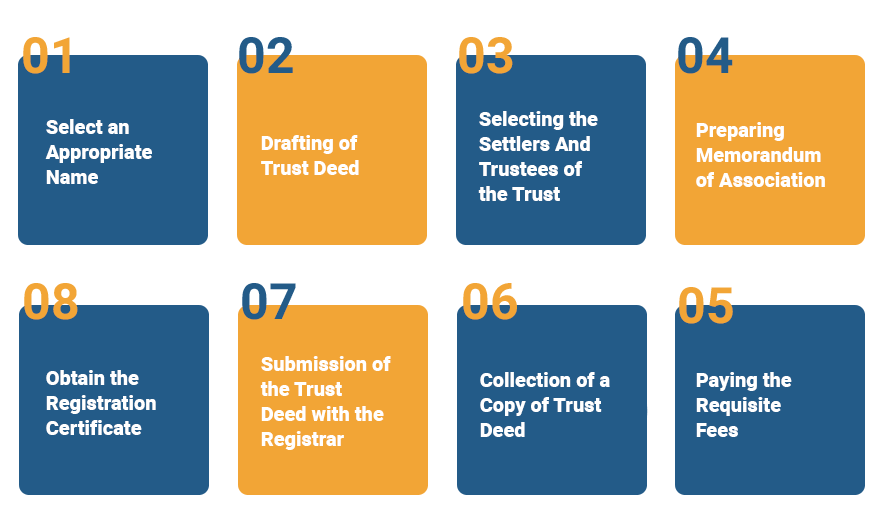
- Select a Name for Your NGO:
Government has banned some names in a list of restricted names in the provision of the Emblems and Names Act, of 1950. Consider checking this list and having a discussion among the members of your NGO before registering your organisation.
- Drafting of Trust Deed:
A trust deed is a document full of registration information. One must submit this deed before the registrar at the time of registering the Trust.
- Selecting Trustees & Setters of the Trust:
The next step is to select your trustees and setters. The government has not limited the number of trustees and setters for any NGO. But there is a minimum limit of 2 trustees to form an NGO.
- Prepare Memorandum of Association:
Prepare a memorandum of the association to showcase the charter of the Trust.
- Paying the Fees:
Now, you need to pay the rightful fees of the registration for your Trust.
- Collection of a Copy of the Trust Deed:
The next step is to collect the certified copy of your Trust Deed within 1 week after submission from the registrar's office.
- Submission of the Trust Deed in Registrar:
Once you have collected the certified copy of the Trust Deed, you now need to resubmit the same at the local registrar along with the properly attested photocopies.
- Obtain the Registration Certificate
Now the final step is to collect the registration certificate from the registrar's office. The registrar will keep the photocopies of the certificate and give you the original.
R2 Experts Procedure for NGO Registration:
You must follow the above-given steps to register your NGO in government official documents. Registration will help you gain benefits in the form of better-quality charitable activities under legal supervision. The team of R2 Experts will assist you with our valuable guidance at each step of your registration process. We guide you in planning a seamless registration process for the smooth operation of your NGO. Our assistance will help you get a successful conclusion in the process. An attorney is required to remove all the pitfalls of the process. We suggest you hire an attorney with credible NGO experience. You must provide the attorney with elementary information and rightful payment to start the work from his side.
Why R2 Expert?
R2 Experts is a hub of professionals who are specialised in the field of legal & financial requirements of an organisation. We give all kinds of legal services for the registration of your NGO. We focus on giving an unmatched experience to all our clients. That’s why we are highly regarded and appreciated by our clients. We also offer top-tier transparency in the complete process of registering the NGO. You can track your progress on our platform only. We are just a phone call away from you. We give you excellent support and seamless conversion of all queries and process details.
- Purchase A Plan for Expert Assistance.
- Add Queries Regarding NGO Registration
- Provide Documents to R2 Expert Expert
- Prepare Application for NGO Registration+ Complete all Admissibility Criteria for Preliminary Screening
- Complete Procedural Actions
- Get your NGO Registration at your Door Step!
Do You Have Any Questions?
NGO registration in India comes under subsequent laws
- Any resident individual
- Any foreigner
- Any registered partnership
- Any company registered under the Companies Act, 2013
- Any registered society
- NGO Registration
- Trust Registration
- Society Registration
- Section-8 Company Registration
- NGO Darpan Registration
- Co-Operative Society Registration
- 12A and 80G Registration
- 12AA Registration
- 12AB Registration
- FCRA Registration
- Privated Limited Company
- OPC (One Person Company)
- Partnership Firm
- Limited Liablity Partnership
- Startup India Registration
- MSME Registration
- ISO Certification


